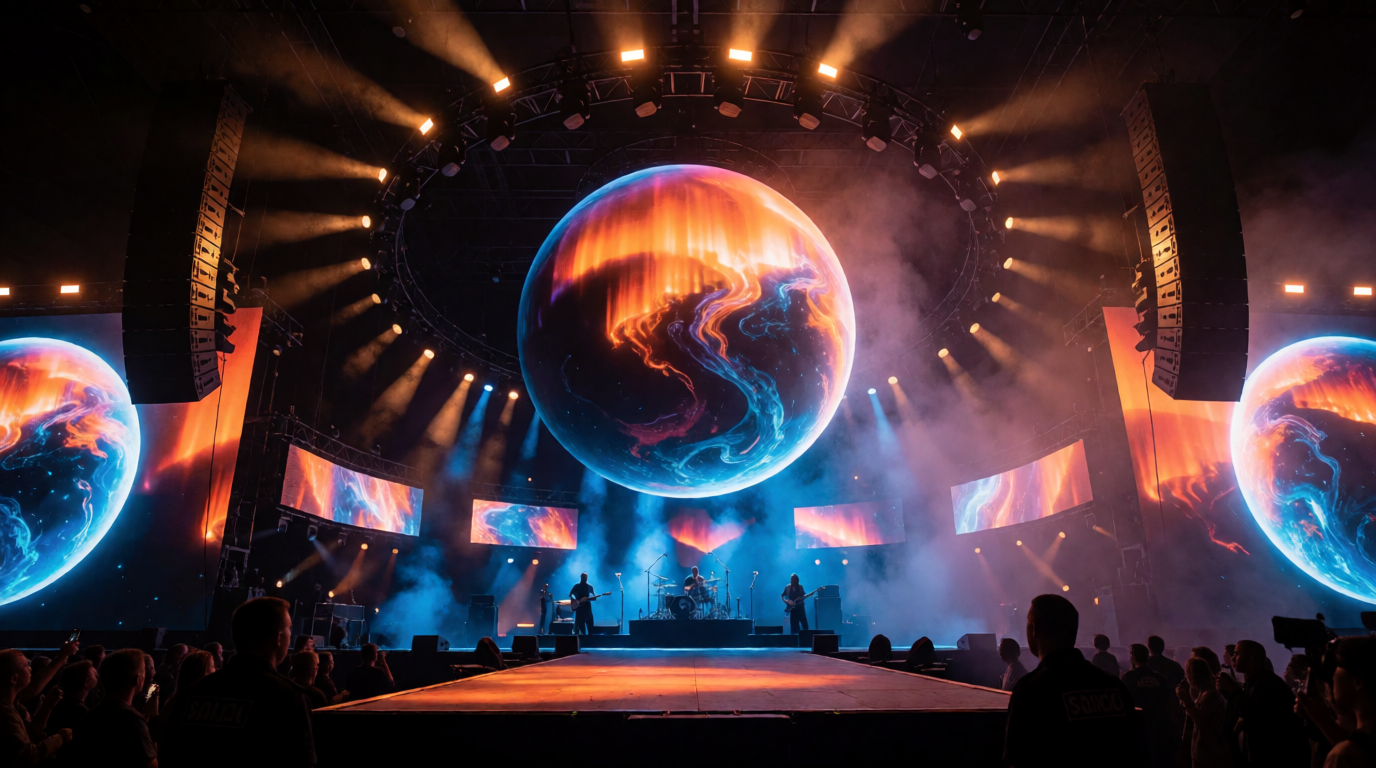
Playa dust, desert heat and the sound camp that kept the music alive in a place that wanted it dead.
Electronics hate dust, heat and neglect. A desert is full of all three. This is the story of a team of audio engineers who built a sound system for an art-and-music gathering in an alkali desert, discovered that the real opponent was the environment and became, by necessity, survival experts for their equipment and themselves.
When Machines Meet Dust
Dust has plagued machines since the first industrial age. In the 1930s, the Dust Bowl blew topsoil across the American plains, clogging engines and filters. Military engineers developed air filtration and sealed enclosures for desert warfare, lessons later adopted by civilian industries.
Entertainment technology has followed suit. Manufacturers such as Pelican, Hardigg and SKB make sealed cases. IP-rated fixtures and weatherproof loudspeakers, such as those from d&b audiotechnik, Meyer Sound and Martin Audio, handle rain and dust better than their indoor cousins. But no gear is immune to the fine, alkaline powder of a playa.
The Camp
The event was a week-long desert gathering, where participants built temporary “sound camps” in a dry lakebed. The audio team, led by a determined woman named Perpetua, designed a system for a camp hosting daily DJ sets and a nightly dance party. The system comprised a Funktion-One Resolution PA, six F221 subwoofers, a Pioneer DJM-V10 mixer and a Powersoft X8 amplifier rack.
The conditions: daytime temperatures of forty degrees Celsius, nights near five, relative humidity below ten per cent and dust storms that dropped visibility to metres. The nearest supply store was two hours away.
The First Dust Storm
On the second day, a whiteout swept across the playa. Wind gusts reached sixty kilometres per hour, carrying a fine alkaline powder that crept through every crevice. The team scrambled to cover equipment with tarps and plastic sheeting.
When the storm passed, they found dust in everything: speaker cones, connector sockets, mixer faders, fans. The Pioneer mixer’s crossfader felt gritty. The Powersoft amplifiers’ fans clogged. A Shure Axient receiver refused to power on.
Perpetua realised that alkaline dust is not only abrasive but also conductive when it absorbs moisture, which happens at night as temperatures drop. A dusty circuit board can short.
- Seal electronics in cases when not in use.
- Install dust filters on amplifier and rack intakes, and clean them daily.
- Use compressed air and soft brushes, not vacuum cleaners, which create static.
- Apply conformal coating to critical circuit boards before the event.
Technique: The Daily Ritual
Perpetua established a daily ritual. Each morning, the team cleaned filters, wiped connectors with isopropyl alcohol and DeoxIT contact cleaner, and checked cables for abrasion. Each evening, they covered equipment with Tyvek sheets and sealed racks with gaffer tape.
She also created a dust zone map: a diagram of the camp showing wind direction and sheltered areas. The mixer and amplifiers sat inside a geodesic dome with a fabric windbreak on the prevailing side. The speakers stood on platforms to keep them above dust drifts.
She added desiccant packs to cases to absorb moisture at night. She also equipped each rack with a temperature and humidity sensor, logging data to a laptop.
The Heat Problem
Heat was the other enemy. Amplifiers, rated for forty degrees, ran hotter in the sun. The Powersoft units, designed to throttle automatically, reduced output when temperatures reached 85 degrees internally. The sound softened, to Perpetua’s annoyance.
She built a shade structure from reflective fabric and added evaporative coolers, low-tech but effective in dry air. She also positioned the amplifier rack on the shaded side of the dome and installed 12-volt fans to improve airflow.
She learned to schedule the heaviest use for evening, when temperatures dropped, and to run lower levels during the day.
Survival of the Crew
Perpetua’s team also faced human challenges. Dehydration, sunburn and fatigue are real hazards in the desert. She enforced a hydration schedule, with water stations and electrolyte tablets. She required hats, sunscreen and dust masks. She set up a cooling tent with misters for breaks.
She also introduced a buddy system: each crew member had a partner who checked on them every two hours. Mental health matters too: isolation, exhaustion and constant noise can wear people down. She scheduled quiet hours and rest shifts.
Power and Water
Power came from a diesel generator and a bank of solar panels with lithium batteries. Perpetua monitored the load with a Victron Energy system. She calculated that the PA’s average draw was 3 kilowatts, with peaks of 8. She programmed the batteries to cover peaks and the generator to run at steady load.
Water was scarce. The team carried a hundred litres per person per week, including washing water. They used greywater evaporation systems to comply with leave-no-trace principles. Nothing was left behind.
Business Insights: Extreme Events, Specialist Skills
The desert experience became a niche for Perpetua’s company. They developed an Extreme Environments package for remote events, including dust-proof racks, cooling solutions, solar power and crew welfare plans. Clients ranged from desert festivals to polar expeditions.
The company priced the package with logistics, equipment hardening and training. Clients valued the expertise: a failed system in a remote location costs far more than the package’s price.
They also built a field maintenance manual, a guide to cleaning, drying and repairing equipment in harsh conditions. It became a minor bestseller in the live-sound community.
- Offer hardened equipment kits for extreme sites.
- Include crew welfare in event budgets.
- Document environmental protocols and training.
- Partner with specialist suppliers for power and cooling.
Software and Tools
Perpetua used Powersoft ArmoníaPlus, Victron VRM, Smaart, Windy and Google Sheets for logging. She kept a repair log with photos of every failure. A satellite messenger, a Garmin inReach, provided emergency communication.
The Dust Settles
On the final night, the dome glowed amber. The speakers thumped, dancers swirled in clouds of dust and the stars wheeled overhead. Perpetua, standing at the mixer, felt the vibrations through her boots.
After the last track, a camp member handed her a cup of water. “You kept the music alive,” she said. Perpetua laughed. “We kept ourselves alive. The music followed.”
The Takeaway
Audio engineers who become survival experts learn that the environment is part of the system. Seal, clean, cool and care for the crew. A sound system that survives the desert can survive anything.
