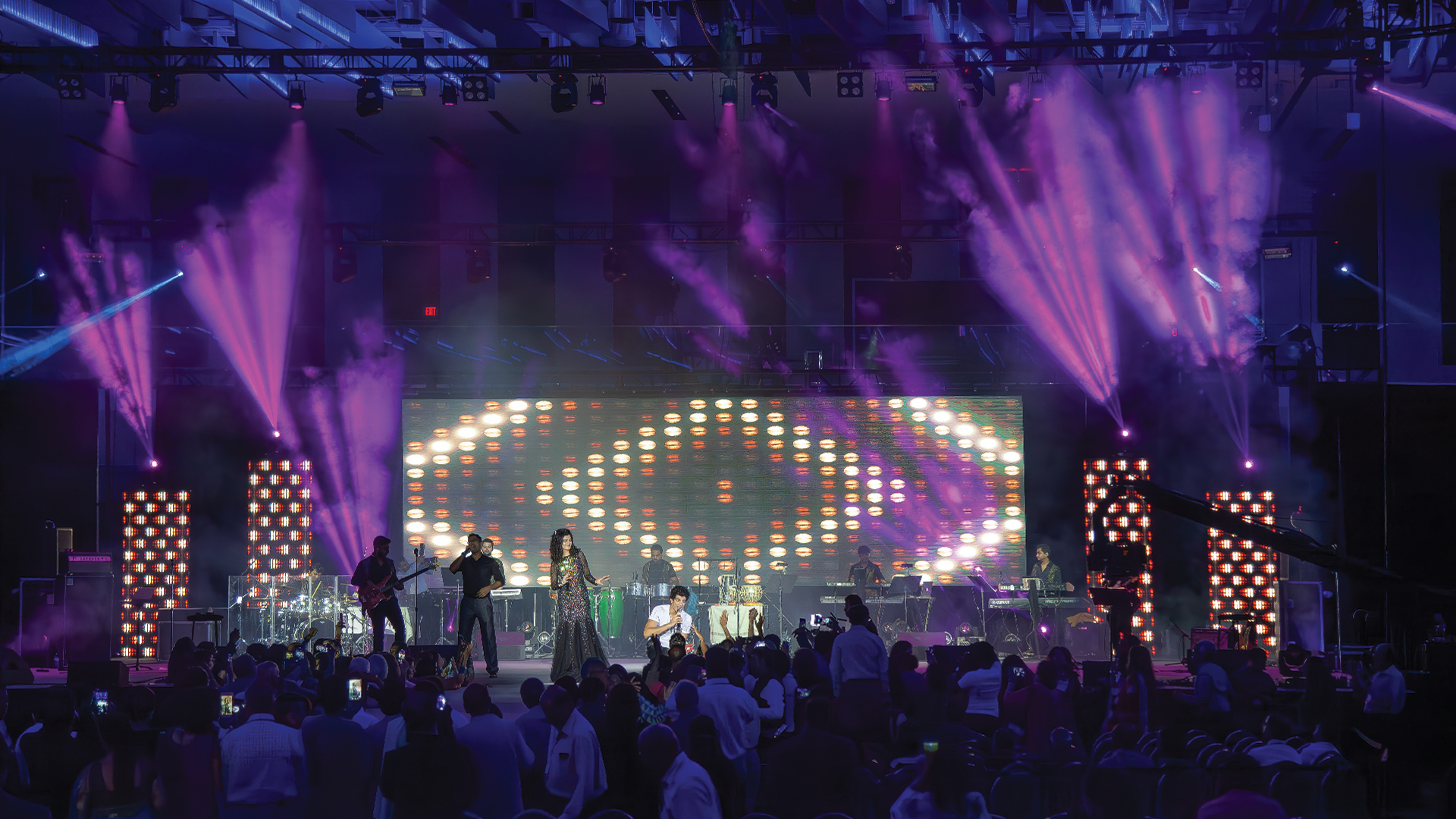
The LED wall behind the presenter displays not a company logo or presentation slides, but a slowly evolving abstract landscape geometric shapes breathing in gradual rhythms, colors shifting imperceptibly, creating an environment rather than delivering information. This decorative application of LED technology challenges the assumption that video walls exist primarily for content display, opening creative possibilities that transform stages into living, luminous spaces.
The Evolution Beyond Information Display
Early LED video walls served strictly functional purposes—displaying logos, running presentation content, and broadcasting speaker close-ups to distant audience members. Production designers treated these surfaces as rectangular screens to be hidden when unused or tolerated as necessary infrastructure when active. The decorative potential of thousands of programmable light points went largely unexplored, constrained by assumptions inherited from projection era thinking.
The shift toward decorative LED applications emerged from entertainment productions where budgets allowed experimentation. Concert designers working with artists like Beyoncé and U2 discovered that LED surfaces running ambient content created atmospheric depth impossible through conventional scenic approaches. Corporate event producers observed these techniques and began adapting them for business contexts, recognizing that decoration and information could coexist across shared surfaces.
Content Categories for Decorative Application
Effective decorative LED content falls into distinct categories, each serving different atmospheric purposes. Abstract geometric patterns provide visual interest without literal meaning—shifting shapes, evolving lines, and morphing forms that engage peripheral attention without demanding focused interpretation. These patterns work exceptionally well during networking segments and meal functions when audiences should engage with each other rather than with screens.
Nature-inspired content brings organic warmth to technological environments. Subtle water reflections, drifting clouds, and gentle forest canopy movement create psychological comfort that rigid geometric spaces often lack. The biophilic design movement, documented extensively in architectural literature, supports this approach humans respond positively to natural references even when those references are clearly artificial representations.
Motion Design Principles for Background Content
Decorative content requires fundamentally different motion design than presentation graphics. Information-driven content uses motion to direct attention—animated arrows, revealing transitions, and kinetic typography that demands viewer engagement. Decorative content does the opposite, using motion slow enough to avoid attention capture while providing enough variation to prevent the dead, static quality of still images or solid colors.
The mathematical sweet spot falls between one and five percent frame-to-frame change—sufficient movement to register as alive without triggering the attention mechanisms that faster motion activates. Content creators working in After Effects, Cinema 4D, or real-time platforms like Notch develop skills in ambient motion design that conventional motion graphics training rarely addresses. The discipline involves restraint that feels counterintuitive to designers trained for impact and engagement.
Color Temperature Coordination
Decorative LED content must coordinate with stage lighting color temperatures to avoid visual conflict. When key lighting runs warm tungsten tones around 3200K, cold blue LED backgrounds create uncomfortable visual dissonance that audiences sense even if they cannot articulate the source. Production teams establish coordinated color palettes during pre-production, ensuring decorative content complements rather than competes with lighting design intentions.
The coordination extends to brightness relationships. LED walls outputting at full intensity overwhelm stage lighting attempting to focus attention on presenters. Decorative applications typically operate at twenty to forty percent of maximum brightness sufficient for ambient presence without overpowering focused illumination. The dimming creates additional benefits: extended panel lifespan, reduced power consumption, and decreased heat generation that helps venue climate control systems maintain comfortable temperatures.
Real-Time Generation Versus Pre-Rendered Content
Decorative LED content can come from pre-rendered video files or real-time generation systems, each approach offering distinct advantages. Pre-rendered content, typically created in After Effects or similar compositing software, guarantees consistent appearance across playback instances what was approved during review will appear exactly as designed during shows. The predictability suits risk-averse corporate environments where surprises are unwelcome.
Real-time generation using platforms like TouchDesigner or Notch provides infinite variation that pre-rendered approaches cannot match. Algorithms create ever-evolving patterns that never exactly repeat, maintaining freshness across multi-day events where pre-rendered loops would become noticeably repetitive. The technical complexity increases significantly—requiring capable playback systems and operator expertise—but the results justify the investment for productions seeking cutting-edge visual experiences.
Audio Reactivity as Decorative Element
Linking decorative content behavior to audio signals creates responsive environments where walls breathe with presentation rhythm. Simple implementations tie brightness levels to audio volume, brightening during speech emphasis and dimming during pauses. Sophisticated systems analyze frequency content, mapping bass energy to one visual parameter, midrange to another, and treble to a third, creating multidimensional responses that feel organically connected to program audio.
The implementation typically involves audio analysis plugins within media server software, converting audio signals to control data that modifies content parameters. Products like TouchDesigner include native audio analysis capabilities, while platforms like Resolume require external analysis tools like Ableton Link or dedicated audio-reactive plugins. The technical setup demands testing during sound checks, calibrating sensitivity levels until visual responses feel appropriate rather than excessive or imperceptible.
