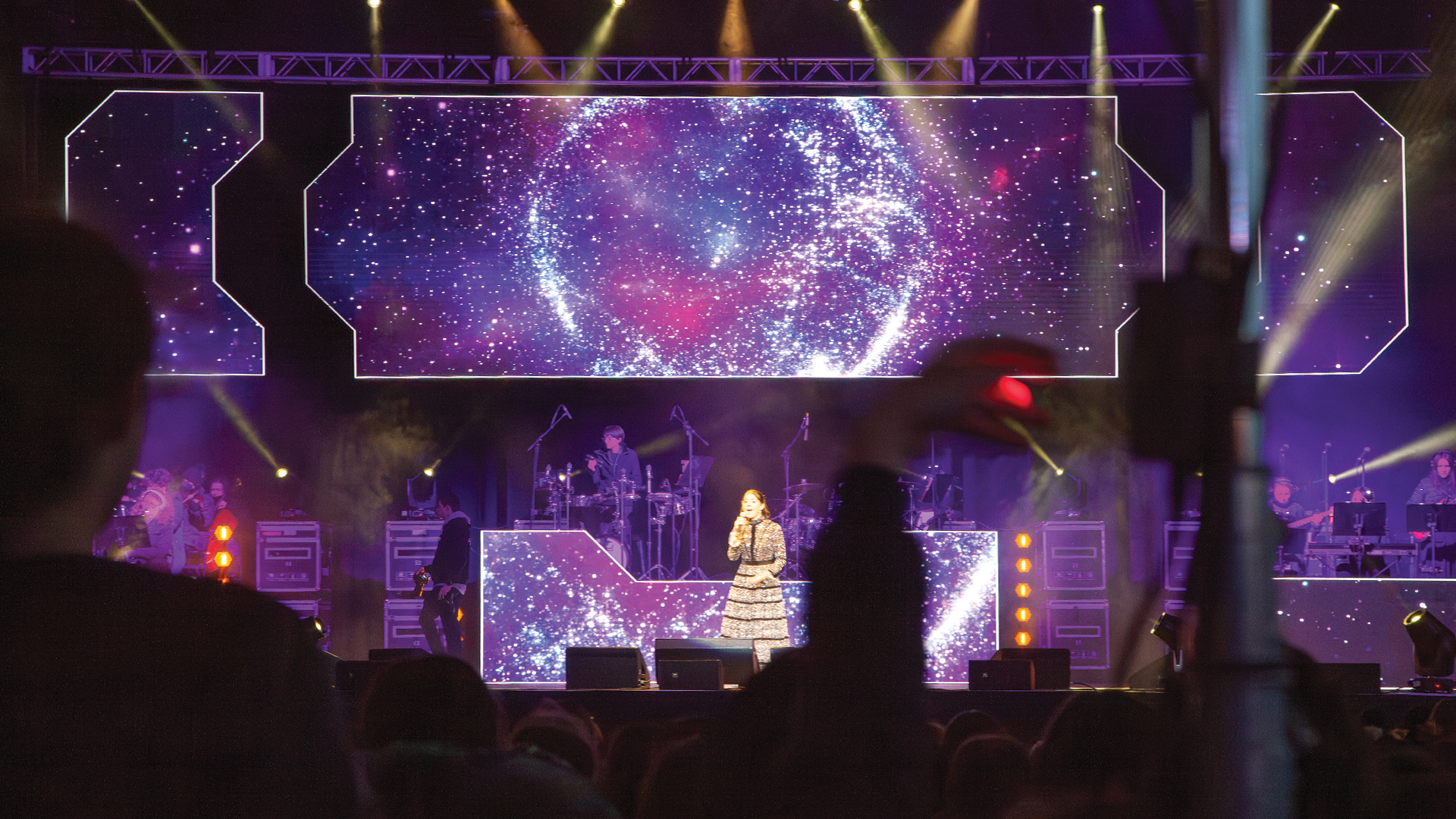
The LED wall behind your presenter can function as either a rectangular distraction or an integrated scenic element. The difference lies entirely in content philosophy. Productions that treat LED surfaces as oversized television screens miss transformative opportunities. Those approaching LED walls as programmable scenic architecture create environments impossible through traditional construction.
Disguise and Green Hippo media servers enabled this evolution through generative content tools creating environmental imagery directly within media server software—particle systems, fluid simulations, reactive visualizations—without requiring external content production.
Environmental Content Categories
Organic motion content creates living backdrops. Slowly evolving particle fields, gently shifting color gradients, and drifting abstract forms provide visual interest without commanding attention.
Architectural simulation transforms LED surfaces into virtual scenic construction. Rendered columns, projected moldings, simulated materials suggest physical presence without fabrication expense.
Brand environment content immerses audiences in visual brand identity without logo application—brand color palettes as abstract gradients, geometric patterns reflecting brand design language.
Content And Scenic Integration
Edge blending between LED walls and physical scenic elements creates unified visual environments. Scenic reveals through content coordination create dramatic moments—LED walls displaying opaque surfaces suddenly becoming transparent.
Presenter Relationship To LED Content
Z-depth consideration determines whether LED content supports or competes with presenters. Contrast management and color temperature relationships influence presenter appearance and audience focus.
Content Development Workflow
Template-based content development enables rapid customization. After Effects or Notch projects with adjustable variables balance custom appearance with efficient timelines.
Stock content libraries including Envato Elements, Motion Array, and Pond5 offer environmental motion graphics. Real-time generation through TouchDesigner creates content responding to actual event conditions.
Technical Execution Considerations
Resolution planning must match content to actual LED surface dimensions. Color calibration prevents day-of surprises—LED panels render colors differently than standard monitors.
Content format selection affects quality. ProRes and HAP codecs provide quality appropriate for close-proximity viewing while enabling real-time playback.
The LED wall transformation—from display surface to scenic element—represents a philosophical shift. Those seeing screens create presentations. Those seeing programmable scenic architecture create environments.
