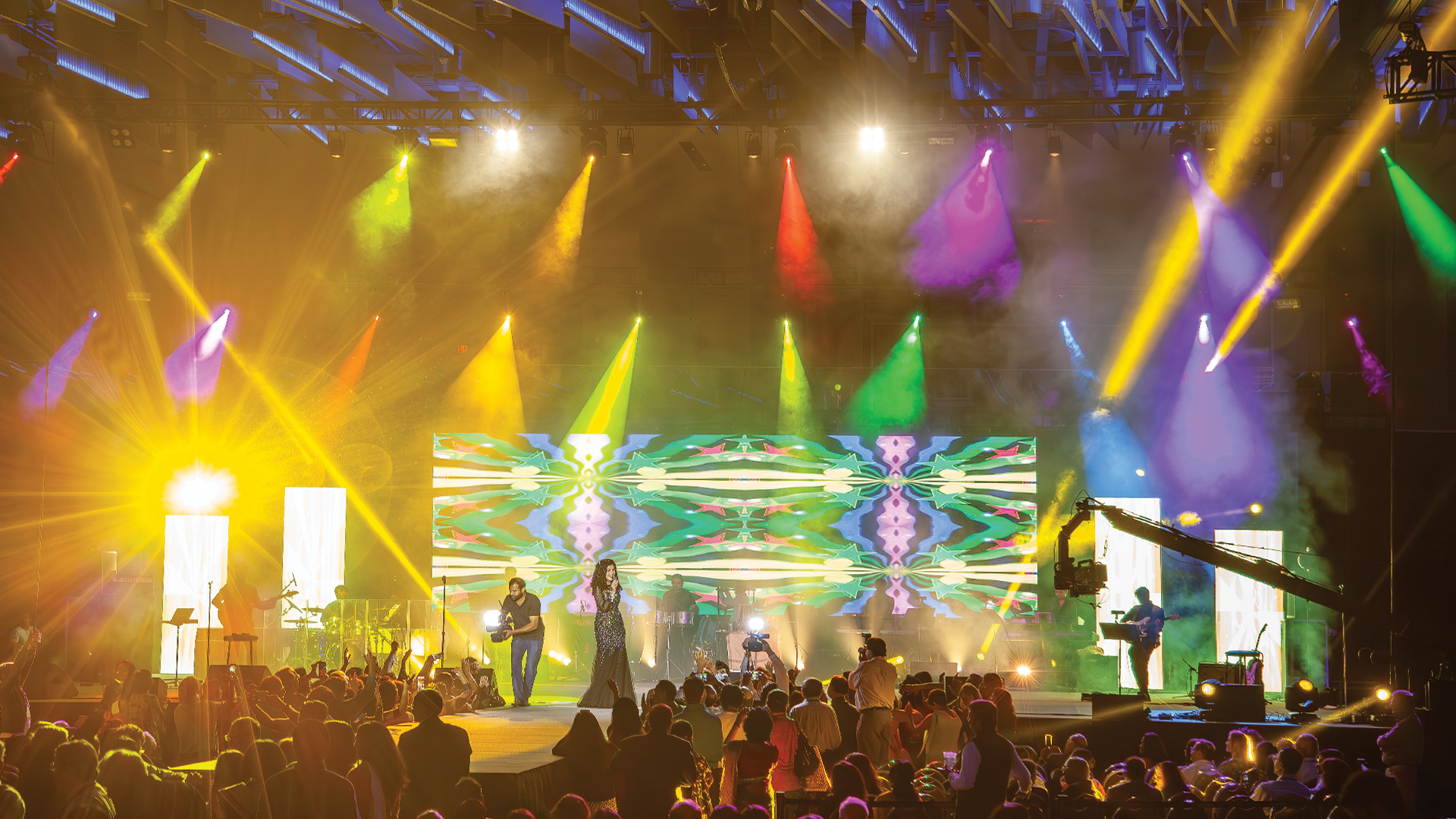
The mixed-format event — a program that combines keynote presentations, panel discussions, award ceremonies, and live musical or theatrical performances within a single production — is simultaneously the most common format in corporate events and the most technically demanding to light well. Each content type has diametrically opposed lighting requirements. A keynote speaker needs a clean, flat, high-CRI key light that renders skin tones accurately for the broadcast camera and eliminates distracting shadows from stage set elements behind them. A live band needs dramatic backlighting, colour wash, and dynamic atmosphere that would completely destroy a corporate speaker’s professional presentation visual. Designing a lighting rig and programming workflow that transitions fluidly between these two worlds — without a 20-minute look change in between — is the core challenge of lighting design for mixed-format production.
Rig Architecture: Designing for Dual Purpose From the Start
The solution to mixed-format lighting begins at the rig design stage, not the programming stage. The rig architecture must accommodate both worlds simultaneously — meaning the fixtures serving each purpose must be physically separate and independently controllable, not shared between functions. The standard approach is a presentation layer — fixtures dedicated exclusively to corporate and speaking content — layered on top of a performance layer that handles all entertainment content. The presentation layer typically comprises high-output LED profile fixtures like the ETC Source Four LED Series 3 or Robe T1 Profile for key light, with LED cyc fixtures and coloured wash units to support screen and backdrop illumination. The performance layer adds moving head wash and beam fixtures — typically Clay Paky Sharpy, GLP impression X4, or Robe BMFL Spot — that remain completely inactive during presentation segments and come to life only when the program transitions to entertainment content.
Camera-Compatible Key Light for Speakers
The most technically demanding aspect of speaker lighting in a mixed-format show is achieving a camera-compatible key light that satisfies both the broadcast camera and the live audience simultaneously. Camera-optimized speaker key light requires: a defined key angle of 30–45 degrees above horizontal and 30–45 degrees off the camera axis, delivering facial modelling without harsh shadows; a colour temperature consistent with the agreed camera white balance — typically 5600K for modern LED key systems; a CRI of 95+ and TLCI of 90+ to ensure accurate skin tone reproduction on camera; and adequate fill light to bring the key-to-fill ratio within the camera’s dynamic range — typically a 2:1 to 3:1 ratio for broadcast applications. The ETC ColorSource Spot and Chroma-Q Color Force 72 are popular choices for the fill and eye-light positions because their high-output RGBW mixing allows precise colour temperature control throughout the session.
Programming Strategy: Pre-Built Looks and Rapid Transitions
On a grandMA3 or Hog 4 console, the programming strategy for a mixed-format show centers on building comprehensive preset libraries — complete lighting states for every content type — that can be recalled with a single cue or button press without requiring live programming. The standard workflow is: build presentation looks as static cues with precisely calibrated key light intensity and colour temperature; build entertainment looks as dynamic cue sequences triggered by timecode or musical phrase; and map both sets to a page structure that allows the operator to instantly select the appropriate look family based on the running program. The transition timing between presentation and performance states — how quickly the rig morphs from corporate clean to concert dynamic — is itself a design choice that must be discussed with the LD and the event director during pre-production, as abrupt transitions can feel jarring while overly slow transitions feel amateurish.
Backdrop and Screen Lighting: The Forgotten Element
The visual background behind a speaker — whether a physical projection screen, an LED wall, or a printed scenic backdrop — interacts with the speaker’s key light in ways that are frequently not considered until the technical rehearsal reveals a problem. A bright LED wall behind a speaker requires the key light intensity to be elevated to maintain adequate key-to-background contrast ratio for camera. A printed fabric backdrop will pick up colour spill from coloured wash fixtures in ways that can subtly shift the background tone on camera. Dedicated backdrop cyc fixtures — LED battens providing even, controllable illumination of the vertical surface — allow the background element to be treated independently of the performer’s lighting and adjusted in real time by the camera shader or DIT to maintain consistent background exposure.
Industry History: The Corporate-Entertainment Convergence
The mixed-format corporate event as a distinct production category emerged in the late 1980s, as major corporations began integrating entertainment production values into their annual meetings and sales conferences. Prior to this period, corporate events were primarily utilitarian — a speaker behind a lectern, a slide projector, and a room full of folding chairs. The influence of MTV and the visual language of music video, combined with the increasing budget ambition of Fortune 500 companies competing to impress shareholders and sales forces, drove rapid production value escalation through the 1990s. Production companies like Jack Morton Worldwide and George P. Johnson pioneered the integration of concert-quality lighting rigs into corporate settings, developing the dual-mode rig architecture that is now standard practice for premium mixed-format events.
