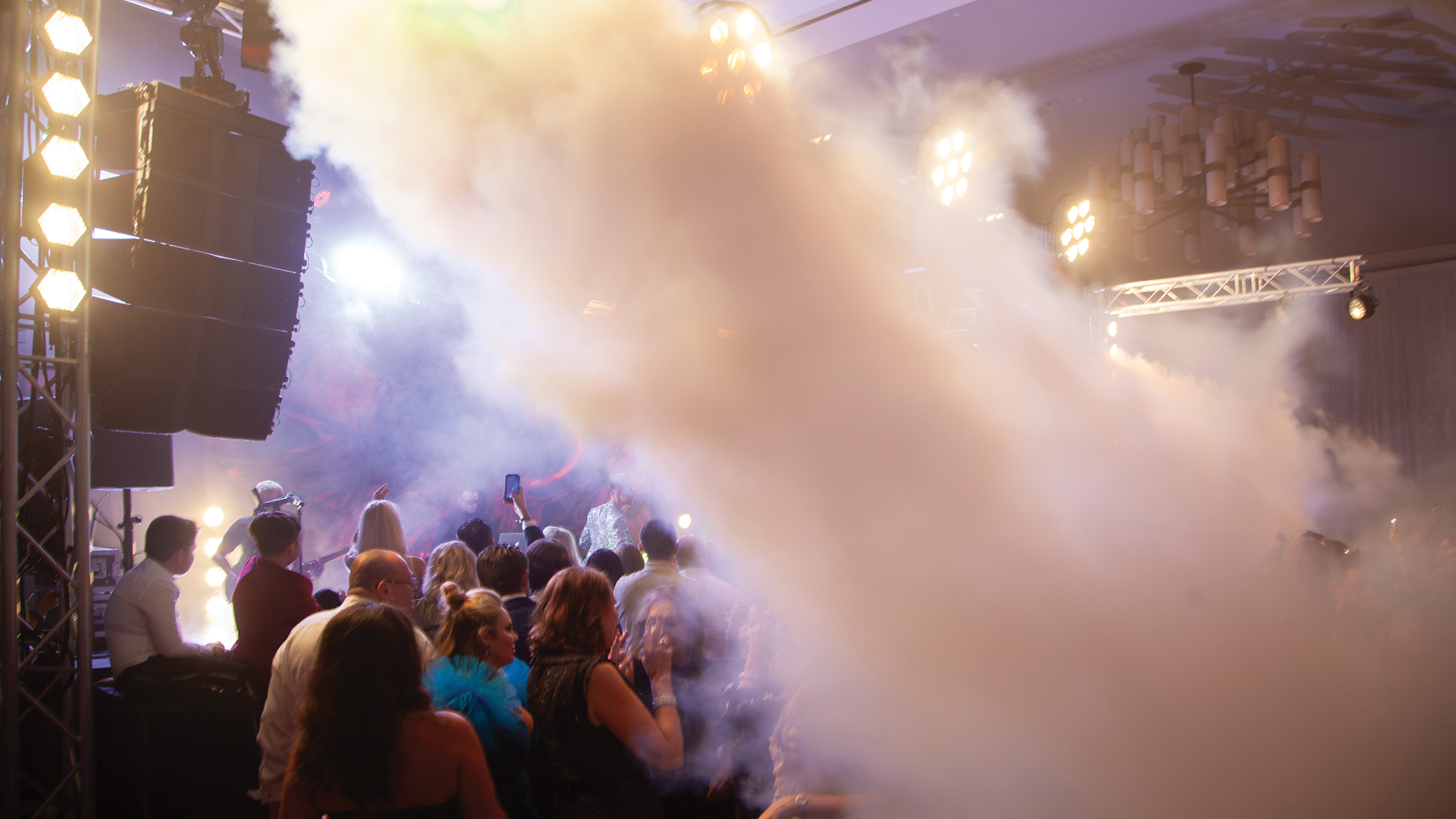
The technical term is atmospheric effects, but anyone who’s worked in live production knows the truth: fog has its own agenda. It doesn’t care about your carefully designed sightlines, your meticulously programmed lighting cues, or your performer’s need to breathe. When fog decides to become the star of the show, it commits fully to the role, filling spaces you didn’t know existed and refusing to dissipate on any schedule but its own.
The Science of Stage Atmosphere
Stage fog exists in two primary categories: haze and fog/smoke. Haze creates subtle atmospheric diffusion that makes light beams visible without obscuring performers. True fog produces dense, low-hanging or enveloping clouds that can dramatically alter visual perception. Different productions require different approaches, but all share one characteristic: unpredictability.
The MDG ATMe and Jem Hydra represent the premium end of haze generation—oil-cracking systems that produce remarkably fine particles for pristine beam definition. The Antari F-7 Smaze and Ultratec Radiance offer more affordable alternatives using different fluid chemistries. Low-lying fog systems like the Ultratec CLF 4000 use liquid CO2 or liquid nitrogen to chill fog, creating effects that hug the floor rather than rising.
Historical Atmosphere in Theater
Atmospheric effects in performance predate modern technology by centuries. Greek theater used smoke from burning resin to suggest divine presence. Elizabethan stages employed ‘thunder runs’—cannonballs rolled through troughs—combined with smoke pots to create storm effects for plays like ‘The Tempest.’
The nineteenth century brought more sophisticated smoke generation, often using burning materials that would horrify modern safety officers. Lycopodium powder—dried spores from club moss—created dramatic flash effects but posed significant fire hazards. Stage managers of that era accepted risk levels that would shut down any contemporary production instantly.
The glycol and glycerin fog machines that emerged in the mid-twentieth century transformed atmospheric possibilities. These heat-based systems vaporized specially formulated fluids to create theatrical fog without open flame. Companies like Rosco and JEM (Le Maitre) pioneered fog fluid formulations optimized for different effects and venue conditions.
When Atmosphere Becomes Obstruction
The transformation from ‘atmospheric enhancement’ to ‘atmospheric emergency’ happens faster than most designers anticipate. I recall a theatrical production of ‘Macbeth’ where the witches’ scene fog—generated by a perfectly calibrated Look Solutions Viper 2.6—decided the entire act needed similar treatment.
The venue’s HVAC system, which should have been cycling fog out continuously, had a zone damper failure that nobody detected during tech. Instead of exhausting fog, the system recirculated it. By scene three, the audience could barely see the stage. By scene four, the actors were shadows. The stage manager called a fifteen-minute intermission while we literally opened fire exits to air out the theater.
The lesson extended beyond mechanical failure. Theatrical fog density changes perception in ways that compound over time. What seems appropriate in the moment accumulates. Designers learn to program atmospheric cues that establish density, maintain it briefly, then allow decay—rather than continuous output that builds toward opacity.
Venue Factors in Fog Behavior
Every venue treats fog differently. Air temperature affects particle suspension—warmer air keeps fog buoyant longer while cold air causes faster settling. Humidity interacts with fog fluid chemistry; some venues’ climate-controlled environments effectively amplify fog output while others accelerate dissipation.
Ceiling height dramatically changes fog dynamics. In low-ceiling venues, fog quickly reaches the overhead and begins pooling, creating stratified layers that look nothing like design intent. In high-ceiling spaces, fog can rise and never return, requiring constant output to maintain stage-level density.
HVAC systems represent the most significant variable. Understanding airflow patterns—where air enters, where it exhausts, how quickly it cycles—proves essential for atmospheric control. Some productions request specific HVAC configurations during performance, either reducing airflow to extend fog duration or increasing it for rapid clearing between scenes.
DMX Control and Automation
Modern fog machines accept DMX control, allowing integration with lighting systems for programmed atmospheric cues. Running fog through the same grandMA3 or ETC Eos console that controls lighting enables coordinated sequences: fog builds as lights dim, reaches peak density as a reveal begins, then decays as the scene develops.
However, DMX control of fog output differs fundamentally from lighting control. A fixture at 50% intensity produces 50% brightness—predictably, repeatably. A fog machine at 50% output produces… some amount of fog, depending on ambient conditions, fluid temperature, how recently the machine ran, and numerous other factors. Experienced lighting designers learn to treat fog cues as suggestions rather than commands.
Some productions employ dedicated atmosphere operators who manually adjust output based on real-time observation. These technicians watch fog density throughout the show, compensating for environmental changes that automated systems can’t detect. It’s an old-school approach, but in unpredictable venues, human judgment often outperforms programmed control.
Health and Safety Considerations
Stage fog safety has evolved significantly. Modern fog fluids from reputable manufacturers undergo toxicological testing and are generally considered safe for exposure levels typical in entertainment applications. The Equity contracts that govern theatrical performance include provisions for atmospheric effects notification and performer consent.
However, individual sensitivities exist. Some performers experience respiratory irritation from fog exposure, particularly with oil-based haze. Productions routinely stock alternative fluid formulations—water-based fluids that produce different visual effects but reduce irritation potential. Communication between production staff and performers about atmospheric sensitivity prevents conflicts during performance.
Fire alarm systems present another consideration. Many smoke detectors cannot distinguish theatrical fog from actual smoke. Venues with suitable fire safety systems can disable or modify detection in performance spaces during shows, but this requires coordination with building management and fire marshals. The alternative—unwanted fire alarm activations during performance—creates its own category of production disaster.
Practical Tips for Fog Management
Start conservative. It’s far easier to add fog density than remove it. Program initial cues at lower output levels than you think you need, then adjust upward during technical rehearsals. The dramatic fog bank that looks amazing in isolation often proves excessive in context.
Account for audience presence. Bodies generate heat that affects air circulation patterns. The thermal load of a full house can dramatically change fog behavior compared to an empty theater. Tech rehearsals without audience often mislead designers about actual performance conditions.
Document environmental conditions. Note temperature, humidity, and HVAC settings during successful rehearsals. When fog behaves differently during performances, comparing conditions can identify causes. Some productions maintain atmospheric logs tracking output levels and environmental factors throughout a run.
Build clearing time into transitions. When scenes require fog-free conditions after atmospheric sequences, program adequate time for dissipation. The alternative—performers emerging into lingering fog that should have cleared—undermines visual storytelling and can create safety concerns with limited visibility.
The fog that takes center stage reminds us that atmosphere is a collaborator, not a servant. We can generate it, direct it, and influence its behavior, but we cannot truly control it. The best atmospheric design works with fog’s inherent unpredictability, creating parameters within which variation enhances rather than undermines the production. That’s not failure to control—that’s understanding the medium.
